In many industries, a Plate Heat Exchanger (PHE) is expected to run continuously with minimum downtime. Yet, one of the most common service complaints in industrial plants is “PHE performance has dropped.”
The real question is:
Is the Plate Heat Exchanger failing?
Or is the system around it being neglected?
At VARALKA, a leading Plate Heat Exchanger manufacturer in India, we regularly receive PHEs for servicing where the actual issue is not manufacturing quality, but poor maintenance practices inside the plant.
A Real Industrial Example
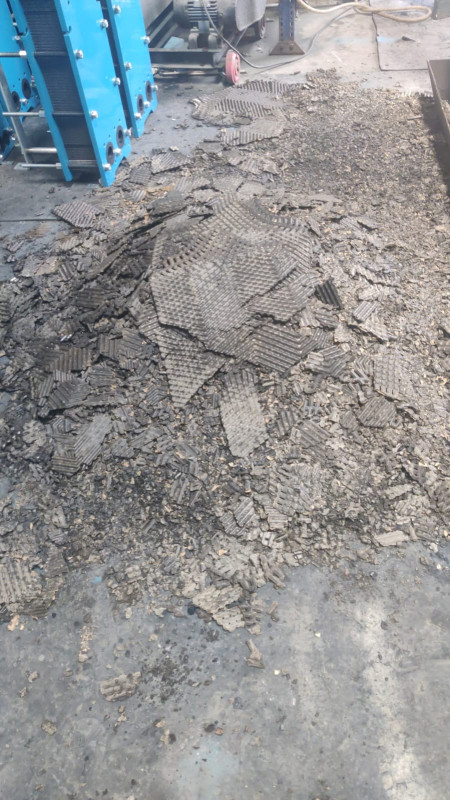
Recently, a customer sent a PHE to us with a complaint of severe clogging.
After opening the unit, we found thick chemical deposits completely stuck between the plates. In several areas, the deposits had hardened into solid layers, restricting proper flow and heat transfer.
The surprising part was that the application was still operating.
This is more common than many industries admit.
A Plate Heat Exchanger Is Designed for Process Conditions — Not Neglect
A Plate Heat Exchanger is one of the most efficient heat transfer systems available today. However, its performance depends heavily on proper operation and preventive maintenance.
Even the best Plate Heat Exchanger manufacturer in India cannot design equipment that can indefinitely tolerate:
- Delayed cleaning cycles
- Incorrect process media
- Excessive scaling
- Chemical settling
- Uncontrolled operating conditions
- Long unattended shutdowns
In many plants, maintenance is postponed until production is affected. By that time, fouling has already reduced thermal efficiency and increased pressure drop significantly.
Why Regular PHE Cleaning Matters
Cleaning a Plate Heat Exchanger on time is not only about maintaining efficiency. It also protects:
- Production stability
- Pump performance
- Energy consumption
- Plate life
- Gasket life
- Process safety
When deposits continue building inside the plates, the flow path becomes restricted. This increases operational stress on the entire system.
In severe cases, plates can get damaged permanently.
The Common Misconception in Industry
Many times, equipment becomes the first thing blamed.
But in reality, most Plate Heat Exchanger failures happen because the operating conditions slowly move away from the original design parameters.
Examples include:
- Using different chemicals than approved during design
- Increasing concentration levels
- Ignoring water quality
- Extending cleaning intervals continuously
- Running systems during partial blockage conditions
A PHE quietly absorbs operational stress until one day performance drops suddenly.
The Role of a Professional Plate Heat Exchanger Manufacturer in India
A responsible manufacturer does more than supply equipment.
At VARALKA, we understand that industrial conditions are not always ideal. That is why our Plate Heat Exchangers are designed considering practical plant realities.
However, long-term performance always requires partnership between:
- Proper equipment design
- Correct operation
- Timely servicing
- Preventive maintenance discipline
No heat exchanger technology can replace operational responsibility inside a plant.
Conclusion
A Plate Heat Exchanger is not just a machine.
It is a critical process asset.
When maintained correctly, a PHE can deliver reliable and efficient performance for years. But when maintenance is continuously ignored, even the best-designed systems will eventually struggle.
The goal should not only be repairing failures.
The goal should be preventing them.
If your plant is facing repeated clogging, thermal efficiency loss, or pressure drop issues, it may be time to review not only the equipment — but the maintenance culture around it.